
Rush Hour Birmingham
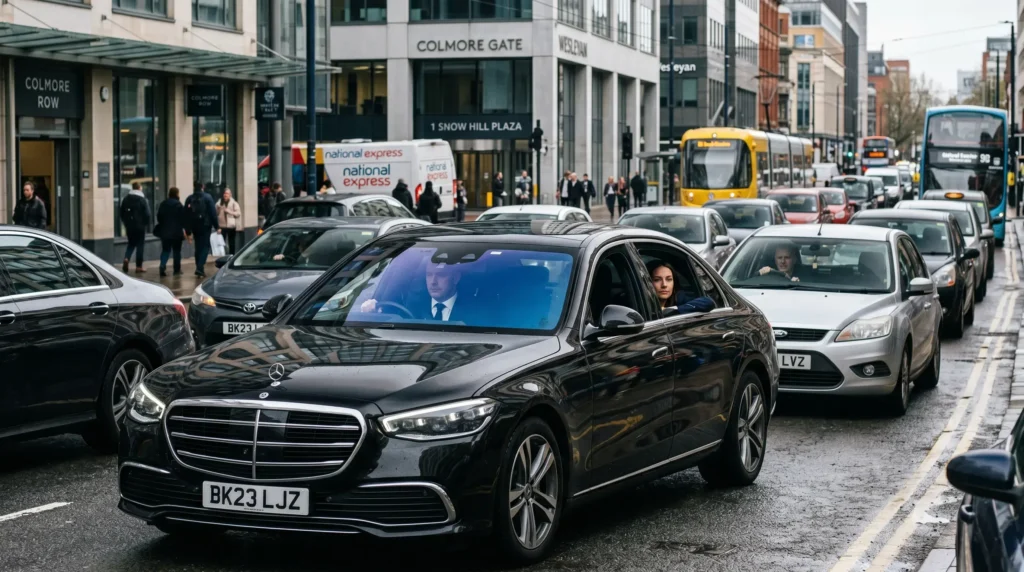
Rush hour in Birmingham runs from 7:00am to 9:30am and 4:00pm to 6:30pm on weekdays. Tuesday to Thursday are the worst days. A 20-minute off-peak trip becomes 45 to 60 minutes during peak. According to TomTom’s 2025 Traffic Index, drivers in Birmingham lost 97 hours to peak-hour congestion last year. That is four full days sat in traffic. Up 2 hours 33 minutes from 2024. The problem is getting worse, not better.
This is the guide I wish someone had handed me the first time I drove through Spaghetti Junction at 8:15am on a Wednesday. Nobody warns you that the M6 between Junctions 5 and 8 turns into a car park before you have finished your coffee. Or that the A38 inbound queues past Salford Circus by 7:45 am. Or that a Friday afternoon journey through the city centre that should take 25 minutes can burn over an hour if an NEC exhibition has just closed.
If you are a business traveller heading to Colmore Row for a 9am meeting, catching a flight from BHX, attending an NEC conference, or just passing through Birmingham on the M6, this page gives you the specific route data, real journey times, and practical workarounds that Google Maps will not show you at midnight.
A professional chauffeur service in Birmingham handles peak traffic differently. The driver checks routes the night before, monitors live traffic on the day, and adjusts the pickup window so you arrive on time without the guesswork. That matters when a missed meeting costs more than the journey.
What Time Does Rush Hour Start and End in Birmingham?
Morning rush hour starts building from 6:45am. It peaks between 7:30am and 9:00am. By 9:30am, most corridors are clear. Traffic hits its lightest between 10:00am and 2:30pm.
Evening peak builds from 4:00pm on most weekdays. Fridays start earlier, around 3:00pm. The peak window sits between 4:30pm and 6:00pm. Roads clear by 7:00pm on most days. Friday evenings can drag until 7:30pm.
The single worst hour on Birmingham’s roads? Thursday between 5:00pm and 6:00pm. TomTom data shows average speeds across the city drop to 19 mph during this window. On corridors like the A38 and Ring Road, that figure falls below 10 mph.
Is Rush Hour Worse at 8am or 9am?
8am is worse. Between 7:45am and 8:30am, three traffic streams collide at once. School runs, office commuters, and delivery vehicles all fight for the same road space. That 45-minute overlap creates the densest traffic window of the entire day.
By 9:00am, school traffic has cleared. The difference is real. If you can push a city centre arrival back to 9:15am, you cut your journey time by 15 to 25 minutes on most routes. I have tested this on the A34 from Great Barr dozens of times. The 8:00am run takes 42 minutes. The 9:15am run takes 22 minutes.
During school holidays, the morning peak starts 20 to 30 minutes later and clears faster. Half-term weeks and the summer break reduce overall volume by roughly 15 to 20 per cent on city centre routes. Nobody mentions this. Both major competitors on this keyword ignore it completely. But anyone who drives Birmingham daily knows school holidays change everything.
The Busiest Roads During Rush Hour
Birmingham sits at the intersection of five major road networks. The M6, M5, M42, A38 and A34 all funnel traffic through or around the city. Over 200,000 vehicles pass through Spaghetti Junction every day. When those routes fill up, there is nowhere for the traffic to go.
M6 Motorway: Junctions 5 to 8
The worst stretch. Junction 6 (Spaghetti Junction) handles traffic merging from the A38(M), the A5127 and the M6 itself. Any minor incident here sends delays in every direction. A clear run through this section takes 8 minutes. During the morning peak, allow 25 to 40 minutes. Junction 5 at Castle Bromwich and Junction 7 at Great Barr are secondary bottlenecks where slip roads back up onto the main carriageway.
A38 Aston Expressway
The main artery connects the city centre to the M6. Inbound traffic slows from 7:15am. By 7:45am, queues build past Salford Circus. Birmingham New Street Station releases a wave of 80,000 daily commuters. When that foot traffic hits the surrounding streets between 5:00pm and 5:30pm, vehicle movement across the city centre drops sharply for 20 to 30 minutes. The Aston Motorway outbound bears the full weight of that evening pressure.
M42: Birmingham Airport and NEC Corridor
Junction 6, the airport junction, is the daily pressure point. Morning departure traffic between 6:00am and 9:00am combines with M42 through-traffic heading towards the M40 and M6. During major NEC exhibitions like Spring Fair, Crufts, or Motorcycle Live, the M42 between Junctions 4 and 7 slows to walking pace. These events pull 30,000 to 100,000 visitors over multiple days. If your travel coincides with an NEC event, add 30 to 45 minutes to any journey on this corridor.
Ring Road (A4540) and City Centre
The inner Ring Road connects Broad Street, Digbeth, the Jewellery Quarter and Aston. The Five Ways roundabout and Dartmouth Circus are the worst choke points. For business travellers heading to Colmore Row, Brindleyplace, or the Mailbox, avoid the Ring Road between 7:30am and 9:00am. Approach Colmore Row from the Snow Hill side instead. Use Newhall Street and Livery Street for the Jewellery Quarter. These are the routes local drivers use because they skip the worst pinch points.
Peak vs Off-Peak Journey Times: The Comparison Nobody Else Gives You
I have never seen another page on this keyword publish actual journey time comparisons. Both top-ranking competitors give vague advice like “traffic can be heavy” or “allow extra time”. That helps nobody planning a real journey. Here are the real numbers.
| Route | Off-Peak | Morning Peak (8:00am) | Evening Peak (5:00pm) |
| Solihull to Colmore Row | 22 min | 45 to 55 min | 40 to 50 min |
| Edgbaston to BHX | 18 min | 35 to 45 min | 30 to 40 min |
| Sutton Coldfield to Broad Street | 25 min | 50 to 65 min | 45 to 55 min |
| NEC to Jewellery Quarter | 20 min | 40 to 50 min | 35 to 45 min |
| Wolverhampton to city centre | 30 min | 55 to 70 min | 50 to 60 min |
| Tamworth to BHX via M42 | 25 min | 40 to 55 min | 35 to 50 min |
| Walsall to city centre via A34 | 20 min | 40 to 50 min | 35 to 45 min |
| City centre to NEC via A45 | 18 min | 35 to 45 min | 30 to 40 min |
These numbers can double if there is a motorway incident, active roadworks, or an NEC event running on the same day.
What About Birmingham’s Clean Air Zone?
Birmingham’s Clean Air Zone covers the area inside the A4540 Ring Road. Non-compliant vehicles entering the zone pay a daily charge. Cars, taxis and light goods vehicles pay £8. Buses, coaches and HGVs pay £50. The zone runs 24 hours a day, every day of the year.
If you are driving a rental car, hire car or older personal vehicle into the city centre, check your vehicle on the Birmingham City Council CAZ checker before you travel. The charge applies per day, not per entry. Get caught without paying, and the penalty is £120.
Neither of the top two ranking pages for this keyword mentions the clean air zone. That is a gap that catches business travellers off guard, especially those driving into the Colmore Business District for the first time.
This is one practical reason corporate visitors and executives choose a chauffeur service for Birmingham Airport transfers and city centre travel. The vehicles are compliant. No charge hits the passenger. No registration check needed. No online payment portal to deal with while preparing for a meeting.
Can You Beat the M6 by Using the Toll Road?
Yes. The M6 Toll runs 27 miles from Coleshill to Cannock. It bypasses Spaghetti Junction entirely. The weekday car rate is £8.30 (2025 pricing). During peak hours, the toll saves 25 to 40 minutes compared to the free M6 between Junctions 5 and 8.
The road is rarely congested because the price keeps volumes down. For through-traffic heading from London or the M40 towards Manchester, Stoke or North Wales, the M6 Toll is the single most reliable time-saver around Birmingham.
If the toll does not suit your route, other alternatives include the A5 via Tamworth (slower but avoids the M6 entirely) and the A452 through Kenilworth (useful for traffic approaching from the south towards Solihull or the NEC). On the south side, the A441 Pershore Road and A435 Alcester Road carry lower volumes than the A38 during peak and work well for trips between Redditch, Bromsgrove and the city centre.
Birmingham Airport: Peak Traffic Changes Everything
BHX sits 8 miles east of the city centre. The main access routes are the M42 at Junction 6 and the A45 Coventry Road.
A city centre journey that takes 18 minutes at 5:00am takes 40 to 50 minutes at 8:00am. For a weekday morning flight departing before 9:00am, leave at least 45 minutes earlier than your off-peak estimate. Friday afternoons and Sunday evenings need an extra 30 minutes on top. NEC event days need another 15 to 20 minutes beyond that.
The BHX drop-off zone charges £5 for up to 10 minutes. The pick-up area inside the multi-storey costs from £4 for 30 minutes. Prices change, so check the airport website on the day.
Government road accident data shows Birmingham records five times more accidents during evening peak hours (4pm to 8pm) than morning peak (5am to 8am). That is 9,439 evening accidents versus 2,047 morning incidents. Friday evenings carry the highest national accident rate. If you are driving yourself to or from BHX during the Friday evening window, leave extra distance to the car ahead. The standard rule is a two-second following gap in dry conditions and four seconds in wet.
Can Someone Explain Why Getting Through Birmingham Takes So Long?
This question comes up on Reddit every few months. The answer is simple, but the fix is not.
Birmingham sits at the intersection of the M6, M5, M42, M40 and A38. Traffic from London heading to Manchester uses the M6. Traffic from Bristol heading to Nottingham uses the M5 to M42. Traffic from the south-east heading to North Wales passes through the same motorway network. All of that through-traffic merges with local commuters, school runs, NEC visitors, delivery vehicles and freight.
Spaghetti Junction alone handles over 200,000 vehicles per day. The road layout was designed in the 1960s for a fraction of today’s traffic. The city has grown faster than the infrastructure.
Is Birmingham a 15-Minute City?
The city centre itself is surprisingly walkable. New Street Station to the Bullring takes 3 minutes on foot. New Street to the Jewellery Quarter takes 12 minutes. Colmore Row to Brindleyplace takes 8 minutes. If your meetings are all within that central corridor, you can walk between them faster than any car will get you there during peak.
But Birmingham as a whole is not a 15-minute city. Suburbs like Sutton Coldfield, Erdington, Kings Heath and Selly Oak sit 20 to 40 minutes from the centre by car during peak hours. The Midland Metro tram and rail connections help, but the daily reality for most residents involves a car or a packed train.
What Is the Best Time to Avoid Rush Hour Traffic?
The quietest road window is 10:00am to 2:30pm on any weekday. Within that, 10:30am to 12:00pm gives you the smoothest run across most routes.
Before 7:00am, roads are open and fast. The 5:30am to 6:45am window is what airport travellers and long-distance drivers use. Wednesday mornings between 4:00am and 6:00am are statistically the quietest period of the entire week, according to traffic analysis data.
Friday afternoons are the opposite. Avoid any journey through Birmingham between 3:00pm and 6:30pm on a Friday. Early-finishing office workers, school pick-ups and weekend travellers create the most unpredictable traffic patterns of the week.
Frequently Asked Questions
What time is rush-hour traffic in Birmingham?
Morning peak runs from 7:00am to 9:30am. Evening peak runs from 4:00pm to 6:30pm. The busiest single hour is Thursday between 5:00pm and 6:00pm. Fridays build earlier, from around 3:00pm, as weekend travellers join the regular commute.
Does Birmingham have rush hour?
Yes. Birmingham is the UK’s second largest city with over 1.1 million residents. Hundreds of thousands more commute in daily from surrounding towns. Five major motorways converge around the city. Peak-hour congestion is a fixed part of weekday travel.
What time does rush hour calm down in Birmingham?
Morning traffic eases after 9:15am and clears by 9:45am on most routes. Evening traffic thins after 6:15pm and clears by 7:00pm. On Fridays, the evening peak can stretch until 7:30pm.
What are the main causes of traffic congestion during peak hours?
Commuter volume from surrounding towns. Motorway junction pressure at Spaghetti Junction. School runs overlapping with office commutes. NEC exhibition traffic on the M42. Delivery and freight vehicles on arterial roads. Roadworks on the Ring Road and A38. And the Clean Air Zone, which has pushed some drivers onto alternative routes around the charging boundary.
What is the best way to get around Birmingham if you have never been before?
Walk inside the city centre. Most destinations sit within 3 to 12 minutes on foot. For airport transfers, NEC journeys or trips between suburbs and the centre, a pre-booked chauffeur hire in Birmingham gives you a named driver who knows the routes, the alternative back streets, and the real-time traffic picture. Public transport works outside peak hours but gets crowded and slow during the morning and evening peaks.
On a weekday, what time between 12pm and 4pm is traffic at its quietest?
Between 12:00pm and 1:30pm. Traffic starts building again from 2:30pm as school pick-ups begin and early-finishing workers leave the city centre.
What times should you avoid driving through Birmingham on the motorway?
Avoid the M6 between Junctions 5 and 8 from 7:00am to 9:30am and 4:00pm to 6:30pm. Avoid the M42 near the airport during the same windows, especially on NEC event days. Travel before 6:30am or after 7:30pm for the clearest run. The M6 Toll bypasses the worst section entirely for £8.30.